
Abstract art
The term ‘abstract’ originally means to withdraw or separate something. In art, it refers to works that either simplify or schematize objects, figures, or landscapes, or use forms like geometric shapes or gestural marks that have no external visual source. Although terms like concrete art or non-objective art are used for 'pure' abstraction, ‘abstract’ is commonly applied to all such art, with distinctions often blurred. Abstract art is frequently associated with virtues such as order, purity, simplicity, and spirituality and has been a central aspect of modern art since the early 1900s.1
Cubist and Fauvist artists used the visual world as their subject matter but paved the way for more radical forms of abstraction. Key figures in pure abstract painting include Kazimir Malevich and Piet Mondrian, active around 1910–20. In abstract sculpture, Russian constructivist Naum Gabo was a notable pioneer, drawing inspiration from the modern world.2
Abstract art is supported by various theoretical ideas. Some advocate ‘art for art’s sake,’ focusing purely on creating beautiful effects. Others suggest that art should be akin to music, using patterns of form, colour, and line to produce effects similar to musical patterns. Derived from Plato's philosophy, the notion that true beauty lies in geometric forms rather than the material world also informs abstract art. Additionally, because abstract art doesn’t represent the material world, it is sometimes viewed as representing the spiritual.3
Painters have always had a unique relationship with the history of their craft. My concerns as an abstract painter are driven by a fundamental question: How can an art form so deeply rooted in its history still find relevance today? How can painting, often seen as an ‘antique mode,’ remain credible in the modern world? And how does reflecting on past art and debates about painting inspire new works that embrace the present while honouring their distinct form?4
I am acutely aware that abstract painting has a rich history tied to modernism and the 20th-century modern movement. This past has absorbed concepts of progress, freedom, certainty, and mastery—ideas that artists have questioned since the mid-1960s. These notions of advancement and independence are evident in both early 20th-century avant-garde movements and later modernist painting traditions.
Western non-objective art has two main strands, which, although related, are not always theoretically compatible. Many artists have found creative tension in this discord, using it as a space for exploration and opportunity.5
One Western tradition of abstract art emerged as a reaction against convention. Early avant-garde artists, such as those in Russian constructivism, viewed abstraction as revolutionary and capable of breaking away from past traditions. They believed it could influence politics and society, aligning with Vladimir Tatlin's call to "put art into life!"6 This movement embraced interdisciplinary approaches, integrating painting forms into architecture, typography, and design (fig.1).
In contrast, another tradition of abstract art values the process of creation and visual form, known as formalist abstraction. This approach is associated with critics like Clive Bell and Clement Greenberg, who emphasized the visual aspects of modernist painting and American abstract expressionism. While related to the Russian model, it is more closely tied to the idea of ‘art for art’s sake,’ which views art’s value as independent of moral, political, or social concerns.7
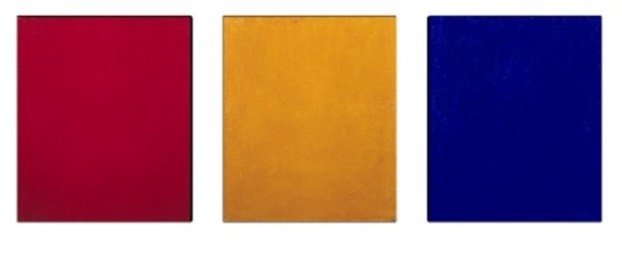
Figure 1. Aleksandr Rodchenko and Varvara Stepanova. Pure Red Color (Chistyi krasnyi tsvet), Pure Yellow Color (Chistyi zheltyi tsvet), Pure Blue Color (Chistyi sinii tsvet). 1921. Oil on canvas. Each panel, 24 5/8 x 20 11/16" (62.5 x 52.5 cm). A. Rodchenko and V. Stepanova Archive, Moscow.
Clement Greenberg, whose influence often constrained artists, saw painting as crucial through a refined process that prioritized visual and formal aspects, aiming to detach art from direct engagement with the surrounding world.
Greenberg viewed modernist painting as a quest to refine the medium’s unique qualities, focusing on attributes like flatness. This concept of ‘material specificity,’ rooted in Gotthold Lessing’s notion that art should embrace its medium’s unique traits, led to increased abstraction. Modernist painting often distanced itself from social and political issues, striving for ultimate clarity and purity, which some critics believed would culminate in minimalism. 8
Artists who reinterpret and challenge the history of painting can be termed ‘indisciplined,’ reflecting how contemporary practices are expanding the boundaries of traditional painting. This term contrasts with Greenberg’s modernist view, which emphasized strict formal qualities and control. Today’s painting often breaks from this restrictive aesthetic, forming new conceptual connections and revisiting earlier, pre-modernist ideas.9
Some contemporary artists engage with the history of modernism and minimalism, using a 'graphic language' that links traditional abstraction with contemporary design. This raises questions about whether abstract painting remains relevant or is merely a reflection of past ideas.10
I recognize the challenge of viewing painting in a historically determined way, or thinking of it as strictly abstract or figurative, or as something separate from other art forms.
Perhaps painting’s unique quality today is its ability to absorb outside influences and blend them with its history. This approach balances the marginal and ‘proper’ aspects of art, allowing for a reassessment of past works and fostering a more open dialogue. It acknowledges the evolving nature of culture and addresses the 'anxieties of influence' that affect creative endeavors, which may be particularly significant for painters.11
David Ryan’s description of Fiona Rae’s 1990s paintings as a “pick-and-mix” aesthetic and a “patchwork of quotes” really resonates with my approach.12
He points out that although Rae’s references frequently touch on contemporary culture, they also engage with art history, especially American Abstract Expressionism, even if they don’t address it directly. Rae reconfigures these references into a “developed collage,” giving them fresh meaning and moving beyond simplistic appropriation (fig. 2).13
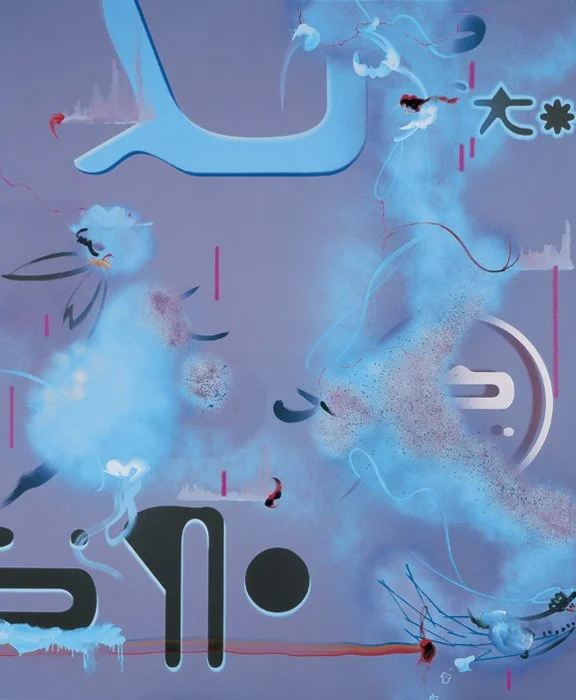
Figure 2. Fiona Rae, Lovesexy, 2000. Oil, acrylic and glitter on canvas, 246.4 x 203.2 cm. Copyright Fiona Rae, Courtesy Timothy Taylor Gallery, London.
Footnotes
Daniel Sturgis, The Indiscipline of Painting, accessed August 10, 2024, https://www.danielsturgis.co.uk/downloads/IOP_Daniel_Sturgis_Catalogue_Essay.pdf.
Sturgis, The Indiscipline of Painting.
Sturgis, The Indiscipline of Painting.
Sturgis, The Indiscipline of Painting.
Sturgis, The Indiscipline of Painting.
Sturgis, The Indiscipline of Painting.
This refers to Harold Bloom’s ‘anxiety of influence’. Bloom argues poetic, and by extension art, history is structured by Oedipal drives.
Harold Bloom, The Anxiety of Influence: A Theory of Poetry, Oxford 1997, p.30.
Sturgis, The Indiscipline of Painting.
Sturgis, The Indiscipline of Painting.
Sturgis, The Indiscipline of Painting.
Sturgis, The Indiscipline of Painting.
Conceição Cordeiro, Times of ‘Cut and Paste’? A Hybrid Reading of Painting, accessed August 12, 2024, https://www.academia.edu/27885311/Times_of_cut_and_paste_A_hybrid_reading_of_Painting?email_work_card=title.
Cordeiro, Times of ‘Cut and Paste’?